Kitchen tongs should open easily and close securely around the food you cook most often. Try the spring and grip before you choose if you can.
Match the tips to the pan
Silicone tips can be useful on coated cookware, provided their heat rating suits the job. Thin metal tips slide under food more readily on suitable uncoated surfaces.
Choose a practical length
Short tongs give more control when plating or turning vegetables in a skillet. Longer tongs give you extra reach when working over a grill or deep roasting pan.
Check the hinge and lock
A strong spring can tire your hand during repeated turns. Check that the hinge moves smoothly, the lock stays closed in a drawer and trapped food can be cleaned from the tips.
Pick tips for your cookware and food
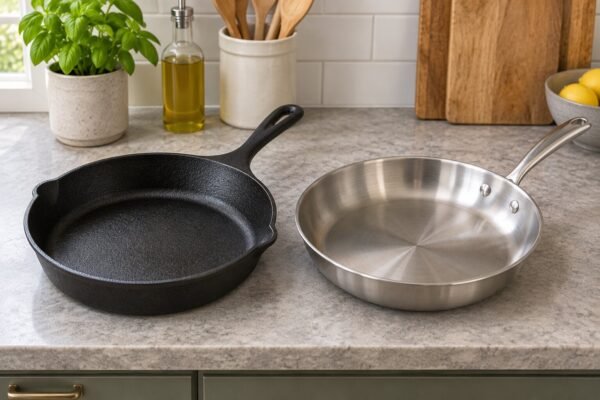
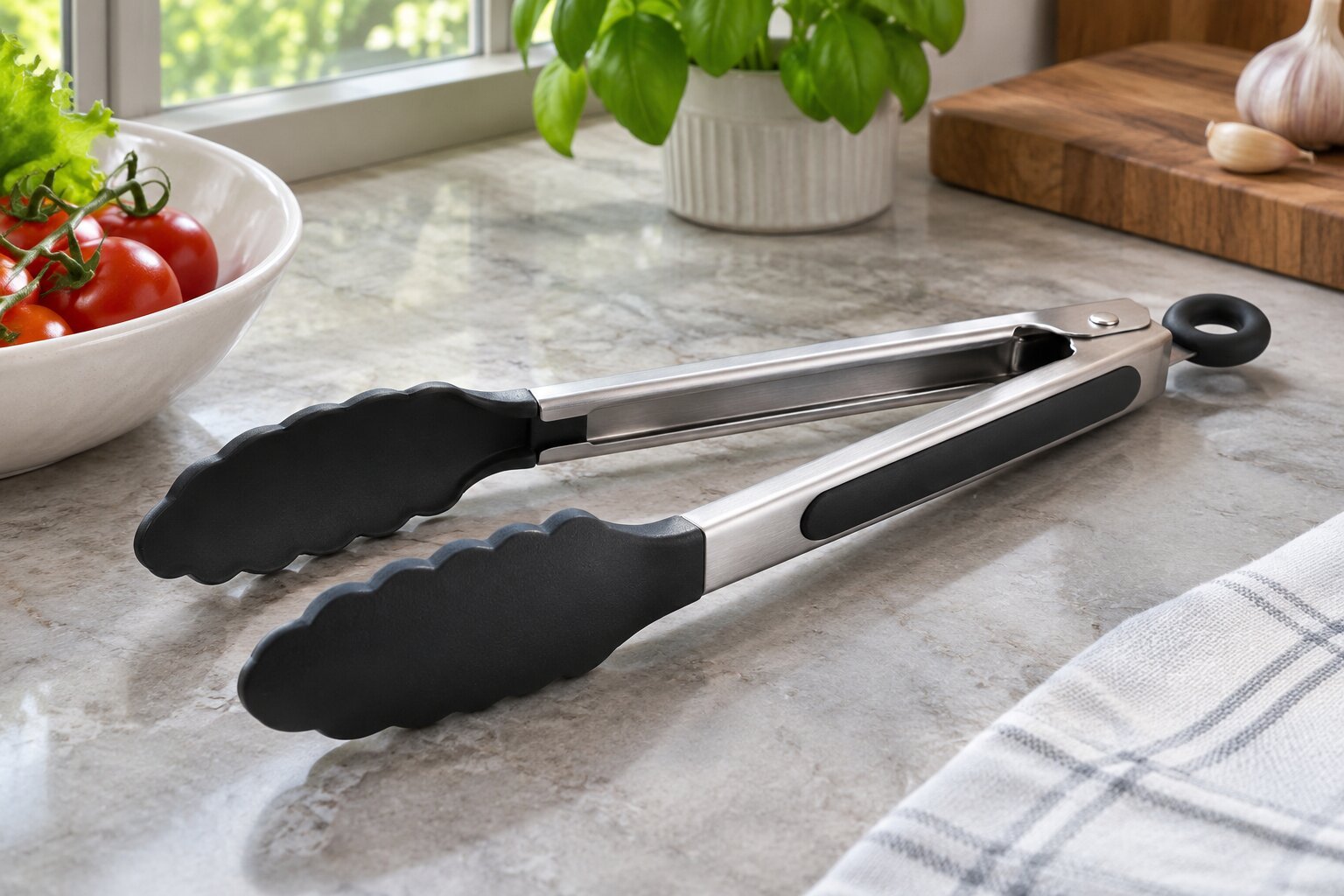
Start with the pan you use most often. On coated cookware, use tips the pan maker recommends, and check the utensil’s heat limits for the way you cook. Broad silicone-covered tips can give you a steady grip on a piece of fish or a few vegetables without a sharp metal edge contacting the coating. Look at where the covering ends, since the exposed arms can still touch a high rim. Thin stainless steel tips are useful on suitable uncoated cookware when you need to slide under the edge of food. Try closing the jaws together and see whether they meet evenly.
The opening at the tips affects what you can pick up. A shallow scallop can hold several soft pieces together, while a narrower tip makes it easier to catch one mushroom or turn a slender vegetable. A very aggressive set of teeth can leave marks in delicate food. A plain broad tip may slip if you turn something small and round. When you can compare models in person, check how securely they grip with a light squeeze before using more pressure. You want enough contact to move the food without crushing it. A set that grips evenly is easier to use than one whose tips twist past each other.
Try lifting the sort of food you turn most often. A thin tip is helpful when the piece lies flat and you need to get underneath it. A more rounded tip can be easier to use with several irregular pieces at once. If the jaws touch only at one corner, check another pair before deciding that the shape is wrong for your task.
Choose length by where you cook
A short pair works well at the counter for plating, moving toast or serving salad. The shorter arms put the tips closer to your hand and make their position easy to judge. For general stovetop cooking, a medium pair gives you more distance from the pan while still letting you see and control the tips. A long pair can help at the grill or when working across a large roasting pan. More reach adds leverage against your hand, so test whether you can hold an object securely without squeezing hard. Check that the handles stay comfortable when you move a few pieces in succession.
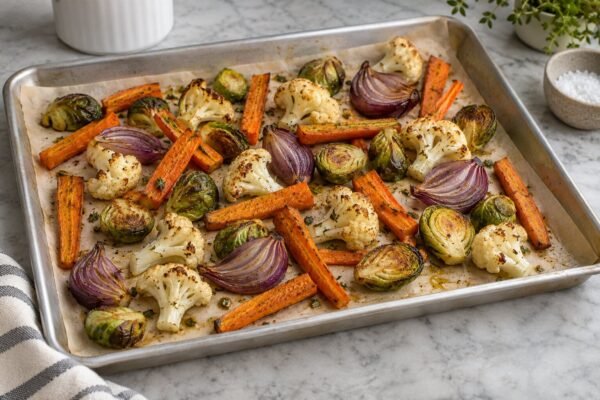
Think about where the unused ends sit as you work. Long handles can project far out from a small skillet or collide with another pan on a crowded stove. Short handles can be awkward over a deep vessel because your hand has to reach closer to the rim. For a large batch of vegetables such as maple mustard roasted Brussels sprouts, try a pair long enough to reach the back of the tray without losing control of individual sprouts. Keep a shorter serving utensil if you often serve from a small shallow bowl.
Test the spring and handle grip
Open and close the tongs several times before deciding whether the spring feels comfortable. A very strong spring can get tiring during a recipe with a lot of turning. A spring that opens too weakly may make it hard to get the jaws apart on the next piece. Look for a smooth return and enough opening to go around the broadest food you expect to lift. Try putting a gentle pinch on just the ends. If the hinge twists or catches when you work one-handed, it is likely to be harder to control once the tips are wet or the food is slippery.
Compare grip position as well as material. Your hand should be able to rest near a comfortable part of the handle without pressing against the hinge. Check whether rubber or silicone grips end before the place you naturally hold. Handles that feel secure when dry may slide more when damp. If you are using tongs for a job that requires repeated reaching, keep the handles clean as you go so you can maintain a consistent grip. For a quick test in your own kitchen, practice picking up a thick slice of bread and a narrow vegetable before using the tongs in a hot pan.
Check the lock and the parts you will clean
A lock makes a pair easier to store in a drawer because the tips stay together. Check that you can engage it without holding the tips shut against a surface, and release it without having the tongs spring open toward another utensil. If you hang your tools, check whether the locking loop is suitable for your hooks. See how much room the closed tool takes in the drawer. Very wide tips can still occupy more space than the handle suggests. A lock that moves freely when the tongs are clean should be simple to keep working if food cannot lodge behind it.
Inspect the hinge and around any removable tips for places where sauce or fat might collect. Follow the utensil maker’s instructions for cleaning and drying. A simple pair with fewer seams can be practical if you often cook with thick glazes. For something you can try immediately, Spanish green beans with garlic and breadcrumbs is a good test of whether the tips can lift several narrow pieces without pressing them flat. Wash the utensil after cooking and check whether the tips and hinge are easy to reach.
Frequently asked questions
Do I need both metal and silicone tips?
Choose for the cookware you use most. A second pair can be useful if it serves a distinct job, such as narrow tips for low-sided uncoated cookware and soft tips for a coated pan.
What length is best for everyday use?
Choose a medium pair if you mainly cook on the stove. Test the reach over your deepest usual pan and make sure you can still grip smaller pieces comfortably.
Are locking tongs essential?
A lock helps in a crowded drawer. If you hang tools or have enough space for the open jaws, give more weight to hinge movement and comfort.
Can I use the same tongs to cook and serve?
Clean them before moving from raw ingredients to cooked food, or use a separate serving pair when that is easier.