A scale makes a recipe easier to repeat when it provides weights. You can also use it to divide batter between pans without estimating by eye.
Tare the bowl
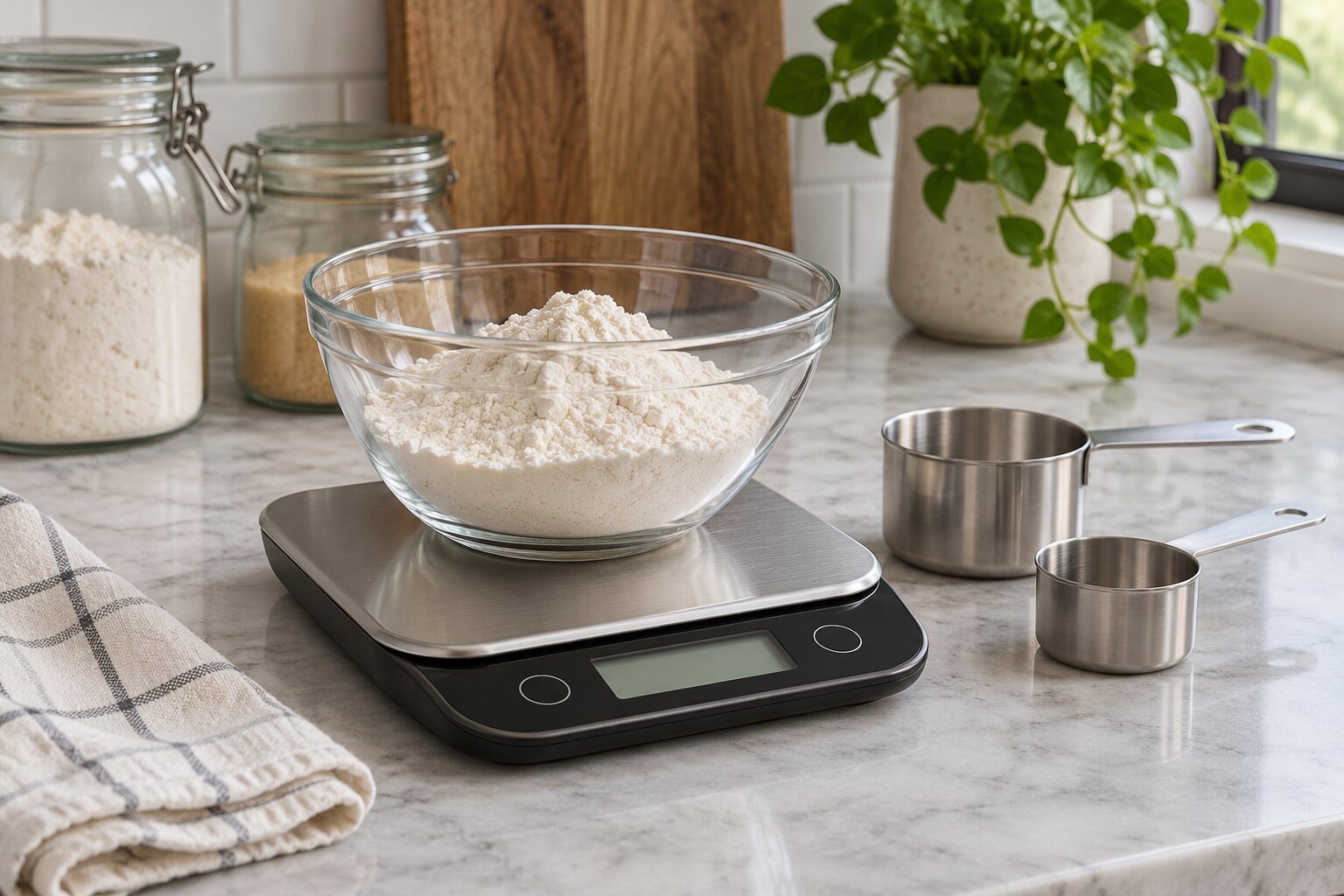
Place the scale on a stable counter. Set the bowl on top, switch to grams and press tare until the display reads zero. Add ingredients slowly as you approach the target.
Weigh ingredients separately when needed
Tare after each addition if ingredients can mix freely. Use a separate small bowl for spices or leavening so you can remove an overshoot without disturbing the main mixture.
Divide dough or batter
Weigh the full batch and divide by the number of portions. Check that the scale can support the combined weight of the bowl and ingredients. For very small amounts, use a scale with appropriate resolution.
Set up the measuring tool
Put the scale on a level hard counter. Check scale capacity against the combined weight of the bowl and ingredients. Start with a level, well-lit area and a tool you can read without turning away from the food. Check the units you intend to use. Write down the target measurement if you are using several values in the same recipe. It is easier to identify a mistake before you add a second ingredient or move the food to a different vessel.
Switch to grams if the recipe gives grams. Place the empty bowl on the scale and tare before adding anything. Follow the maker’s limits for range and where the tool is designed to make contact. Check for low batteries or damage if a reading changes unexpectedly in a steady setup. When first using the tool, compare two readings under the same conditions and pay attention to how long the display needs before it settles.
Get a representative reading
Add flour or sugar slowly as you approach the target. A scoop kept separate from the bowl is easier to use for corrections. Choose a stable point to hold the bowl, food or tool while you read the display. Move liquids and metal cookware only when it is safe to do so. Where a reading depends on location, check a second spot if the first result looks unlike the rest of the food. Take your hand away from the scale or sensor position as appropriate.
Tare again between ingredients only if you can separate or correct their amounts as needed. Use a small container for powerful spices. If working with small amounts, use a separate container when it makes it easier to stop at the target. Record ingredients individually when a mistake would be difficult to undo. One larger adjustment can overshoot, so approach the expected value in small increments if the method allows it. Stop and repeat the measurement if the display is obscured or unstable.
Choose between two common uses
Weighing flour for a cake helps repeat the same crumb. Keep the bowl on the scale while adding flour and stop before overshooting. A recipe example is Italian Lemon Ricotta Cake. Do a small trial first and check how easy it is to reproduce your result with the equipment you already have. The first test is most revealing when it uses a quantity you normally serve.
For pizza dough, weigh the total after mixing if you want equal portions. Divide by their number and correct one portion at a time. See Neapolitan-Style Margherita Pizza Recipe (Home Oven) for another useful example. Compare which stage benefits most from your choice of equipment. Keep an eye on both convenience and the finished texture, especially if the tool makes preparation easier while adding a step later.
Use that reading to make the cooking decision
When portioning batter into pans, compare how much is in each pan rather than assuming both empty pans weigh the same. Apply the reading to the recipe at the point the recipe expects it. Conditions change as food cools, water evaporates or ingredients are moved. Pay attention to which reading you took first. Avoid immediately changing both the heat and ingredient amount unless you are correcting an obvious error with units or setup.
Check whether the display is obscured by a wide bowl and whether the smallest increment is suitable for the amount you need. Check whether the tool’s tolerance is appropriate for what you are doing. A small discrepancy is important for a concentrated ingredient or a cooking temperature target. If a measurement seems far from expectation, check the units and conditions first. Confirm the target in the recipe or a trusted source before relying on an approximation.
Clean and protect the measuring tool
Keep liquid away from gaps in the platform and display. Clean as directed and store flat if the manufacturer’s instructions recommend it. Wipe the contact and reading surfaces according to the maker’s directions. Avoid leaving damp residue in a compartment or around a seam. Store the tool where its working point and screen will not be crushed. General cleaning and proper storage are useful for helping the tool give a stable next reading.
If the reading drifts, check stability and battery condition. Retare an empty bowl rather than guessing where the display started. Write down which unit, mode or position gave a clear result the first time. That makes a repeated recipe easier to compare and gives you a simple reference when the result changes. If several tools can perform the same job, use the one rated for the range and conditions you actually need.
What to check before buying or replacing one
Choose readable units, a stable platform and enough capacity for your largest normal bowl. Small amounts may need a separate tool with finer precision.
A display showing to the nearest gram can be good for flour and sugar. For tiny portions of a strong ingredient, check whether the scale responds accurately at its lower limit.
Repeat an ordinary measurement a second time before relying on a new tool in a demanding recipe. Check the display is readable where you actually cook. A reading that shifts when the tool moves or the battery is low will be hard to reproduce. Compare the measurement with a second point or a known reference as appropriate for the device.
Use your normal workflow when judging digital kitchen scale. Prepare the space first, carry out the most frequent use, then clean and store the item before calling the trial finished. Keep track of any step that becomes easier or any new limitation. Compare at least one other ordinary use before making the decision, since a tool that solves a single fiddly job may be too specialized for the space you have.
Frequently asked questions
What does tare do?
It resets the displayed weight to zero with a container already in place. The container still counts toward the scale’s rated capacity.
How do I correct too much flour?
If possible, remove a little before mixing. Use a separate bowl for amounts that cannot be easily separated once added.
Can I convert all cups to grams at the same rate?
No. Densities differ across ingredients and measuring methods. Use the weight provided in the recipe when available.
Can I place a hot pan on it?
Check maker guidance. Use a suitable heatproof arrangement or weigh after cooling if the platform is not rated for heat.