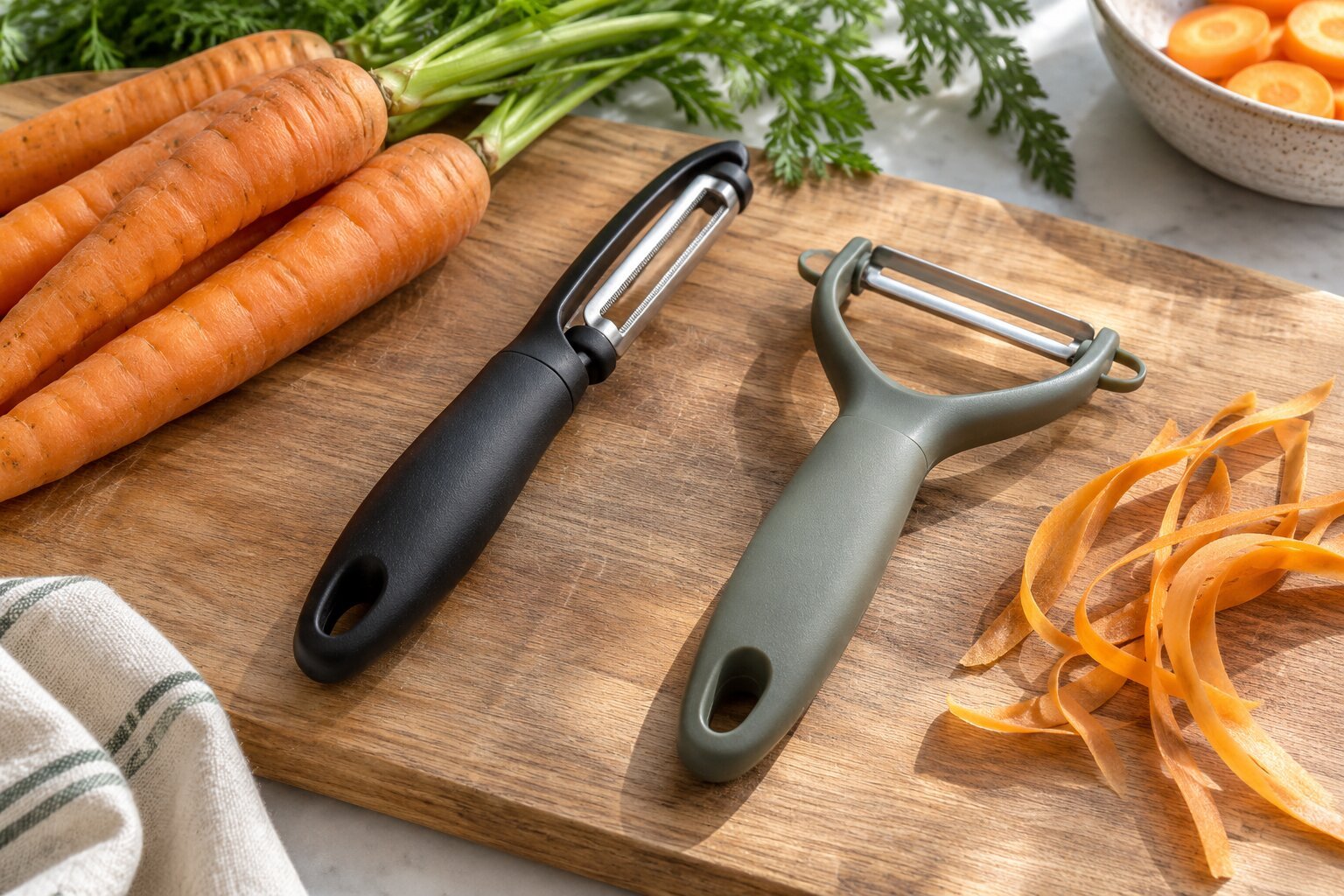
A good peeler should track the produce easily and feel steady in your grip. Which handle shape works best depends on how you hold the vegetable.
When a Y-peeler is useful
On a Y-peeler, the blade spans the two arms at the end of the handle. That layout puts the cutting edge across the direction of the pull and makes broad strokes feel natural. Lay a carrot on a cutting board, hold it at the wider end and draw the blade from the middle toward the far tip. Rotate the carrot after each pass so a small strip of skin remains visible between strokes. Move your grip to the peeled end to finish the upper part. With a blade that tracks well, you should only need one pass over most areas. Several passes over the same line can leave grooves in the vegetable.
A Y-peeler also makes sense for zucchini and cucumbers when you want long strips for presentation or when you need to remove alternating bands of skin. Its width can make it easier to keep an even line. If you are preparing a batch of carrots for Greek roasted carrots with feta and oregano, test whether you like the texture of the skin first. Young carrots often only need scrubbing. For thicker skins, the Y-peeler is a convenient way to peel several long vegetables without changing how you hold the tool.
When a straight swivel peeler is useful
A straight swivel peeler places the blade in line with the handle, so the tool feels more like a short knife in the hand. It can be convenient for following the shoulder of a potato or the rounded side of an apple a little at a time. Use short, light strokes and turn the produce to keep the blade in contact with the area you are peeling. On a very irregular potato, peel the broad surfaces first and then work around the dents. If the tool has an eye remover, use it only for small spots the blade cannot reach. Trying to dig them out with the peeling edge can take off more flesh than necessary.
The straight shape can be handy when you need to work around a stem or a narrow end. That does not mean a straight model always works better on round produce. The angle of the blade and the way it pivots matter as much as the handle shape. A Y-peeler with a freely moving blade can follow the curve of an apple quite well. If you often peel apples for baked oatmeal with apples and cinnamon, pick whichever peeler lets you turn the fruit without having to regrip the handle between every stroke.
Compare grip, blade movement and cleanup
Start with how the handle sits in your hand. You should be able to hold it firmly without pinching it between your thumb and index finger. A narrow handle may feel nimble when you are working around small fruit. A thick handle can be more comfortable if you are peeling a whole bag of potatoes. Try using the same grip with slightly wet hands to see whether the handle feels steady. Also check how much room your knuckles have when you work toward the cutting board. If the handle forces your hand into an awkward angle during a simple pass, changing the produce or the blade material is unlikely to solve the problem.
Check whether a new blade pivots smoothly as it meets a curve. It should move enough to follow the produce, then come back into position without sticking. A peeler that repeatedly skips over a smooth carrot may be dull, clogged or held at the wrong angle. Clear the slot and try a shallower stroke before assuming the shape is wrong for you. Compare the ribbons left behind. A good result takes off a thin strip while leaving a fairly smooth surface. Deep grooves, repeated catches or torn sections can mean you are pressing harder than the tool needs.
Look at the space around the blade as well. A slot that is easy to rinse makes quick work of peel trapped between strokes. Follow the maker’s washing instructions and clear the slot before the scraps dry. If washing by hand, keep your fingers out of the blade opening and rinse the debris away or use a dish brush. Dry the tool before storing it. Put it somewhere the blade is protected from other utensils and where you can grab the handle without reaching past its cutting edge.
Choose one for what you cook most
If you mainly peel long produce or shave broad ribbons, start with a Y-peeler. If you mostly peel small potatoes and apples, a straight swivel design is worth trying first. If you cook both, use a carrot and an apple as a quick comparison. Peel a small section of each and pay attention to how many times you adjust your wrist, whether the blade follows the curves, and how much flesh comes away. You can usually choose after a handful of strokes. If both feel equally comfortable, favor the one that is easier to clean and store.
Leave tough skins to the right tool. A blade that works neatly on a zucchini may have trouble starting on thick winter squash rind. If the tool catches or the squash rolls, stop and stabilize the vegetable on a board before continuing with a technique suited to that squash. Do not force a peeler through a hard rind or direct a stroke toward the fingers holding the produce. For less demanding tasks, such as trimming a few carrots for dinner, a comfortable handle and a sharp blade will usually matter more than having both peeler shapes in the drawer.
For vegetable ribbons, use a tool wide enough to cover most of the cut face. Set the vegetable on the board and trim a flat side if it rolls. Begin with a couple of short passes so you can see how the blade behaves. Once the surface is even, lengthen the stroke and use only enough pressure to keep the blade in contact. Set aside the narrow first strips for a stir-fry or salad. When the remaining piece becomes too thin to hold securely, stop peeling and slice the rest with a knife on the board. The same approach is useful when shaving a broad carrot for a garnish.
Frequently asked questions
Can one peeler do both jobs?
Yes. A comfortable swivel peeler can handle both straight and curved produce. Choose by the tasks you repeat most and the amount of pressure the blade needs.
Why does the blade clog?
Wide or damp strips sometimes catch in the slot. Rinse them out, then use shorter strokes and see whether that gives the peel room to fall away.
Should I replace a peeler that skips?
Clear the slot and check the angle first. If the blade still catches on several kinds of firm produce or needs noticeably more pressure than when it was new, replace the blade if the model allows it, or replace the tool.