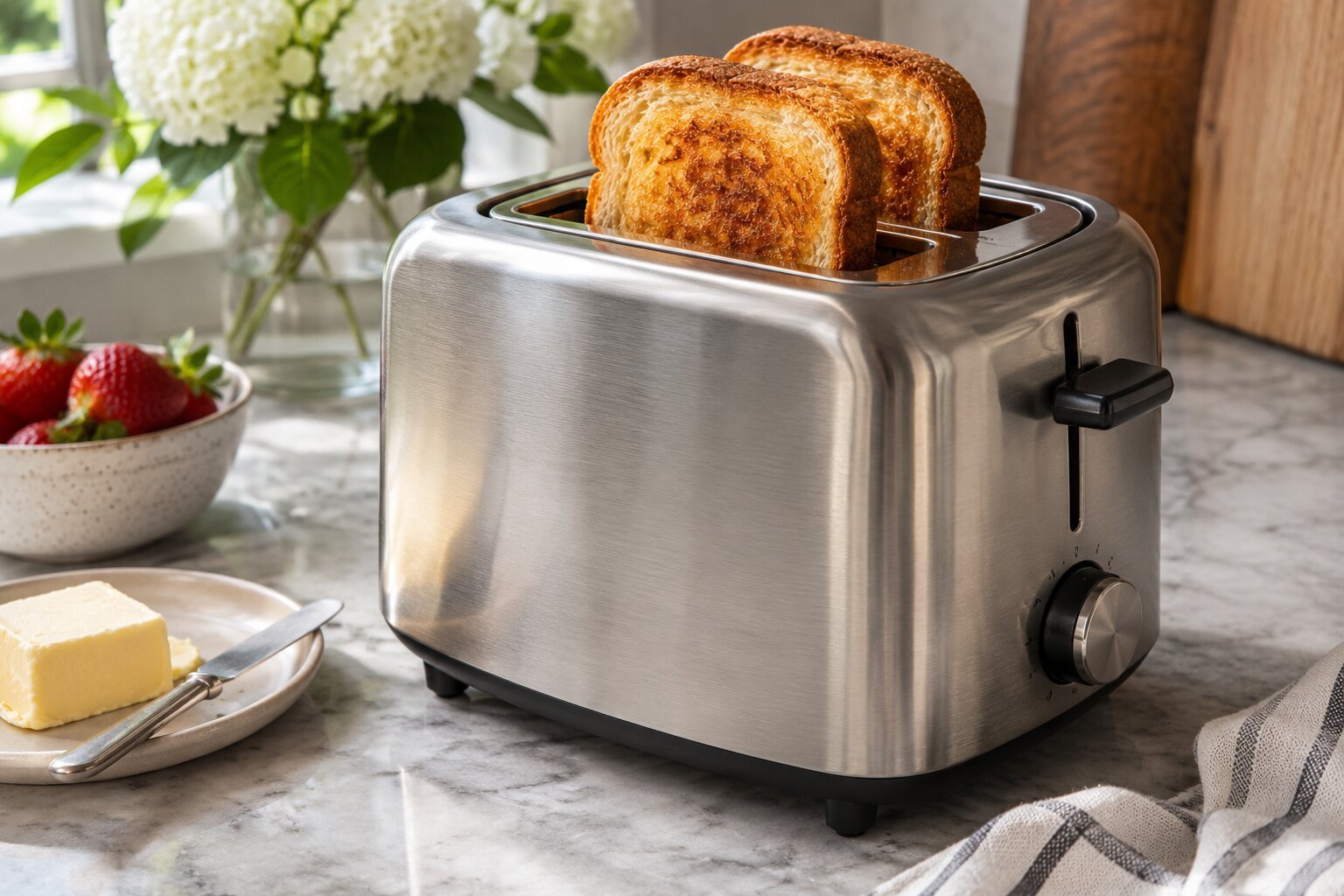
Start with the bread you buy most often. Slot dimensions and access matter more in daily use than an extra mode you rarely select.
Check slot width and length
Measure a typical slice of your bread. A wide slot helps with thick sourdough and bagels, while a longer slot fits larger slices without trimming. Check the lift height for smaller pieces.
Compare browning controls
Look for a dial you can return to easily and a cancel button you can reach without moving the toaster. A dedicated bagel setting varies by model, so confirm what it changes in the manual.
Look at cleanup and counter fit
A removable crumb tray makes routine cleaning simpler. Place the toaster with the clearance specified by the manufacturer and check whether you can slide the tray out without rearranging the counter.
Check how your usual bread fits the slots
Take out the bread you buy most often and measure one of the larger slices. Compare its width, length and thickness with the inside dimensions of the slot, rather than the dimensions of the toaster housing. A square sandwich loaf can fit easily while the end of a long slice of sourdough may stick above the heated area. If you regularly toast a round loaf, a long slot can save you from trimming slices or turning them midway through cooking. If you normally use small slices, check how far the carriage lifts them at the end.
For bagels or English muffins, think about the thickness after splitting them. The halves should lower without rubbing hard against the sides. A wide slot is useful for those thicker pieces, but check that the guides also hold a thin slice reasonably upright. If a slice tilts toward one wall, one side may toast faster. Look at the manual for the sizes the model is designed to accept. If your breakfast often includes very tall slices, check the depth as well as width so the whole area you want browned sits inside the slot.
Choose capacity by how you serve breakfast
A two-slot model fits many small households, especially if each person wants a slice with eggs or fruit. A four-slot model saves a second cycle when several people want toast at once. Consider what you do on a busy morning rather than choosing for the largest breakfast you might serve once a year. A long two-slot toaster can handle long bread while using less width along the backsplash than some four-slot designs. It will still need room front to back and clearance above, so check those measurements in the place you actually intend to use it.
When comparing a four-slot model, look for separate controls if people regularly want different shades of toast. Two independent pairs of slots let you use a different setting for the second pair or leave it empty according to the manual. If everyone eats the same bread and likes the same color, a simpler control layout may work just as well. For a breakfast spread that keeps the toaster from handling every serving, pair toast with apple and cinnamon baked oatmeal so people have another option ready to eat.
Also consider how you stage the rest of the meal. If eggs are ready before everyone’s toast, an extra pair of slots can help you put all the plates down together. If people eat at different times, the smaller model may be a better use of space. Think through the order in which you would load the slices and plate them before paying for more capacity.
Look for controls you can use consistently
A numbered browning control is helpful if you want to reproduce a result. You will still need to try it with your bread. A thin slice from a soft loaf can color differently from a thick slice with a firm crust at the same setting. Start around the midpoint recommended by the maker and adjust after looking at both faces. Note a setting for your usual bread before trying special modes. If you switch to a different loaf, start with a slightly lower setting and compare the first result. Find where the cancel control is before you start so you can end a cycle early if necessary.
A bagel button may change which elements heat or how the cycle runs. Read the particular model’s instructions for which way to face the cut side and what the mode does. A frozen setting is useful if you frequently toast bread out of the freezer and the appliance is designed for that use. If you rarely do either, focus on a clear dial, a comfortable lever and a cancel control you can reach with the unit in its usual spot. For a similar comparison of daily controls and capacity, see how to choose a waffle maker.
Measure counter clearance and crumb tray access
Measure the available counter area and note the outlet position. Use the placement and clearance instructions for the model, including the space above it. Check where the controls face and where the cord comes out. A toaster that fits physically can still be awkward if you have to pull it forward every time to reach the lever. Also measure the storage shelf if the toaster will usually live in a cupboard. Consider its weight and whether you can lift it easily without pulling on the cord.
Find the crumb tray and check which end of the housing it pulls out from. A rear-access tray may require moving the toaster every time you empty it. A front or side tray can be easier if your counter is deep or backed by a wall. Follow the maker’s instructions and let the appliance cool before cleaning. Check how easily the tray fits back in and whether the manual provides a simple routine for the areas that are meant to be cleaned. This matters more than a mode you might never use. If you have very little counter space, compare the access needed for the tray as well as the footprint when it is closed.
Frequently asked questions
Should I get a long-slot or a wide-slot toaster?
Use a long slot for tall or elongated slices and a wide one for thick slices. Look for both dimensions if you buy large rustic loaves with thick cuts.
Is a bagel mode necessary?
Only if the model’s bagel cycle does something you want and you toast bagels often. Check the manual because the effect differs by model.
Is a higher wattage always better?
Use how the model fits your bread and the consistency of its browning as the main criteria. Wattage by itself does not tell you how evenly the elements heat a particular slice.
What should I check for small slices?
Look for a lift that presents small pieces above the opening and follow the manual if something gets stuck. Compare the lift on the model you are considering rather than assuming all carriages rise the same amount.